

Stewards’ Seabird Monitoring program began in 2013, thanks to funding from the Bureau of Land Management. Stewards is partnering with the California Coastal National Monument (CCNM) to monitor breeding seabirds off the Sonoma Coast and is a local Chapter of the Seabird Protection Network.
The Seabird Protection Network works to reduce human disturbance to seabirds and other wildlife along the California coast through an organized outreach and education program combined with law enforcement and seabird management actions. The first step is to monitor local breeding colonies to identify the sources and impact of disturbances. Monitoring the productivity of the species raising their families on these offshore rocks provides documentation of the impact of any disturbance as well as the establishment of new colonies. Seabirds can be flushed off nests by hikers, low-flying planes and helicopters, boats and paddlers, drones, hang gliders and fireworks.
Meeting times: There is one 2-hour shift per week for each breeding colony and though we ask for a commitment of at least one shift per month, many volunteers participate more often to keep up with the progress of the birds raising their families and to enjoy the camaraderie of others in the stunning environment that is our Sonoma Coast. Our monitoring season runs from April 1 through the end of August though due to the trending earlier arrival of one of the species we monitor, we may begin monitoring two of the sites in February or March.
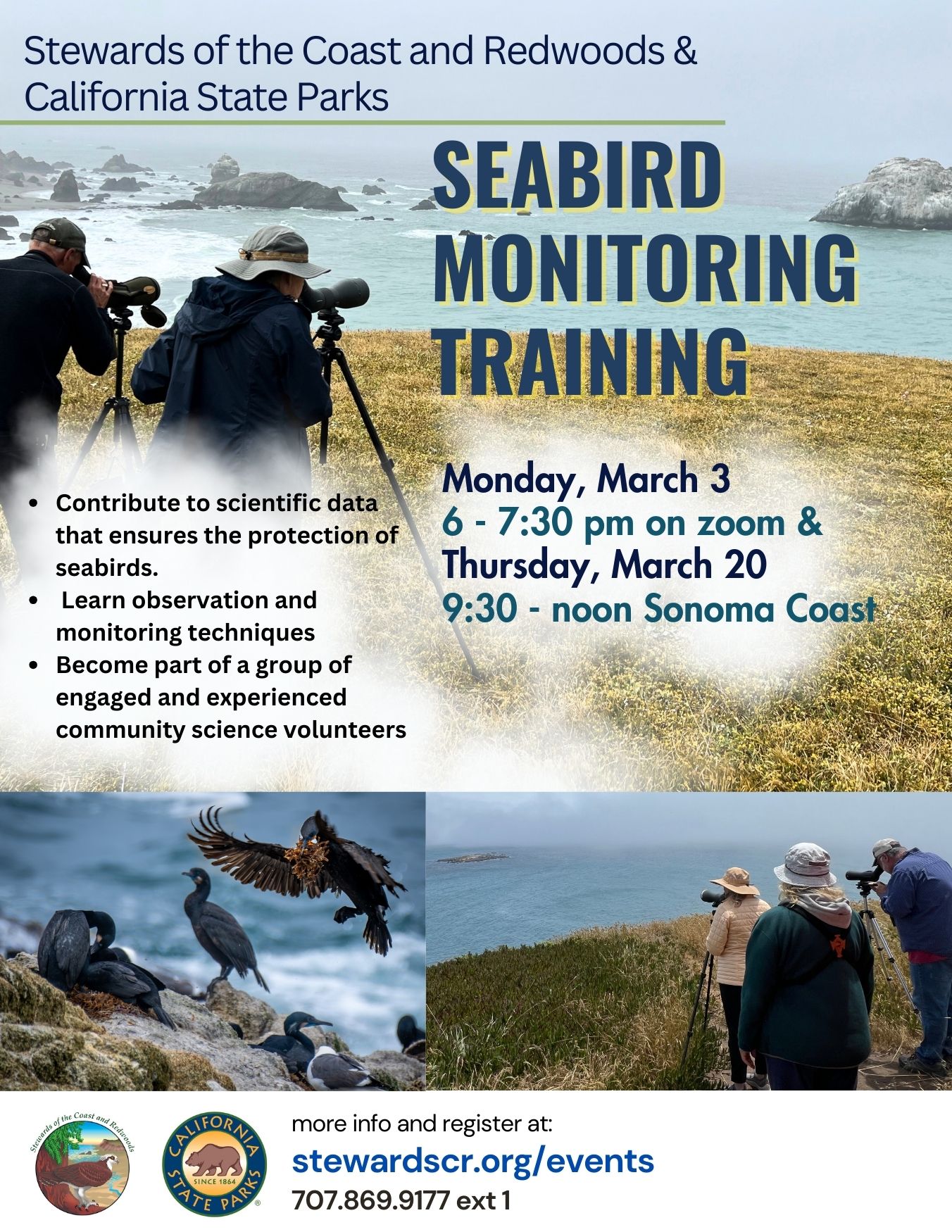
Training and requirements: No prior experience is necessary! New volunteers should register and attend a Seabird Monitoring training. Volunteers will then shadow experienced volunteers until they feel comfortable on their own. New volunteers are required to attend one General Volunteer Orientation, and encouraged to attend seminars to further their education.
Sorry, but this event is sold out.